

On Thanksgiving
The evolution of an ambivalent holiday.

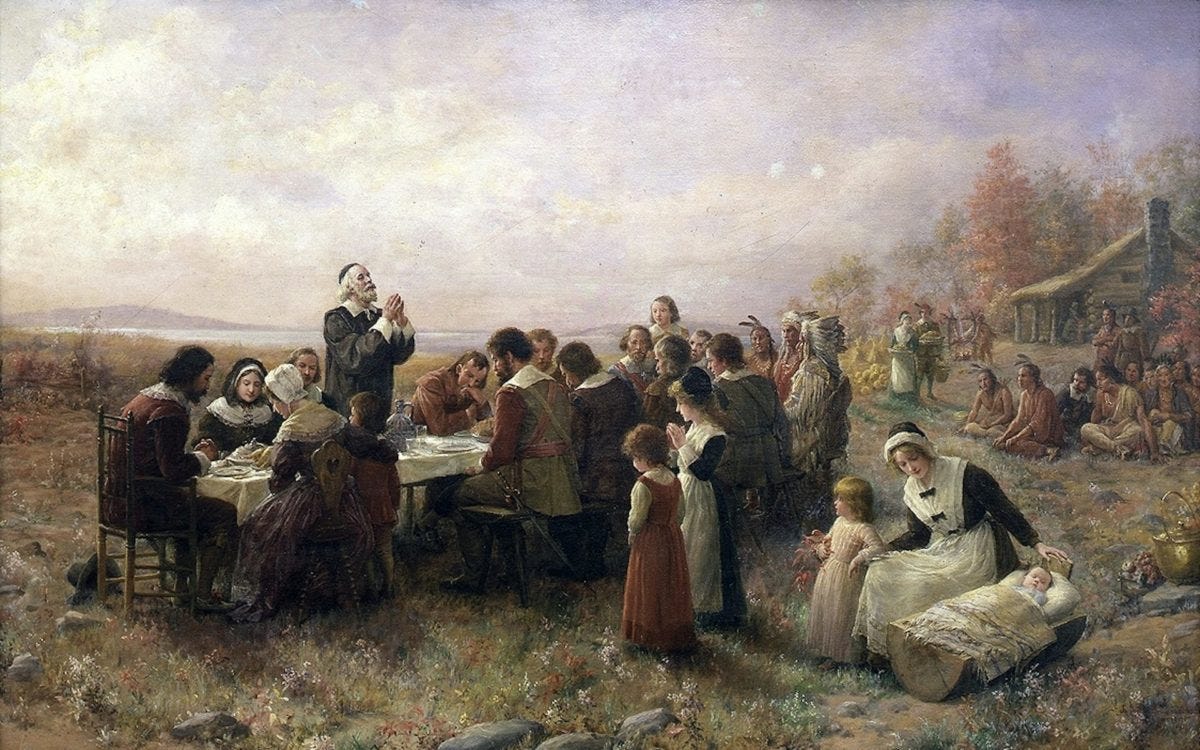
Thanksgiving has come and gone, and I hope you’ve worked through the leftovers. This year was a quieter, easier holiday for me than in years past, and I’m grateful for that. If the holiday is one that is meant as an opportunity to reflect and consider what one has to be grateful for, I’m all for it. Thanksgiving became a national holiday under President Lincoln, and it was meant as a day to give thanks for the preservation of the Union. As you might imagine, as holidays go, when it first became a national holiday, it had its critics and opposition—particularly from those in the Confederacy. Prior the declaration of Thanksgiving as an American holiday, people often had harvest celebrations and days of thanks and feasting. For generations, German immigrants to Pennsylvania and its environs had celibrated Harvest Home, which was a harvest festival and the origin of fall homecoming celebrations. It wasn’t until much later—after the Civil War—that the holiday became associated with the pilgrims arrival on Cape Cod, and their migration to nearby Plymouth, Massachusetts in 1620 and 1621. Because of that association—often seen as the beginning of the greater colonization of North America by Europeans—many people also see the day as one not of thanks and celebration, but of mourning.
The arrival of the Mayflower on the New England coast in 1620 was not anywhere near the first incursion of Europeans on the North American soil, but it was one that has had an enduring legacy. The odds were against the would-be colonists. Of the 102 passengers that boarded the Mayflower, fifty of them would die during the first winter. Of the 102, only about 37 of them were religious separatist fanatics. The rest were opportunists willing to take a big risk for themselves and their families. The story of their arrival and settlement is extremely well-documented, often with primary sources. The English colonizers were a highly literary group, and they had a penchant for self-reflection and documentation which is one of the reasons their story has remained a resonant one.
The story of the 102 passengers on the Mayflower has become the source of myth, celebration and national pride, when it was also the story of yet another hostile colonial land-grab. The land on which the Pilgrims settled was already occupied, and at the time of the Mayflower’s arrival, Cape Cod and coastal Massachusetts were being reclaimed by the Wampanoag residents after the demise of many of the Nauset who had died in an epidemic.
If you would like to learn more about Native American history of our country before, during and after the colonial era, I would recommend An Indigenous Peoples’ History of the United States by Roxanne Dunbar-Ortiz. For a more contemporary history of indigenous America, I would recommend David Treuer’s The Heartbeat of Wounded Knee: Native America from 1890 to the Present.
It turns out some of my own relatives were on the Mayflower. Three of my 11th great-grandparents were on the ship, as well as two of my tenth great-grandparents. I descend from two Mayflower families, the Hopkins family, and the Billingtons. Neither of these families were Puritan separatists, but instead were among the families referred to as “strangers” by their Puritan co-passengers. We don’t really know why either family set sail on such a shaky venture, but we can presume it had to do with economic opportunity and the possibility of living a more expansive life. They may also have run out their luck and their welcome in their hometowns.

Stephen Hopkins—my eleventh great-grandfather—may have had more complex reasons for taking his pregnant wife and three children to North America. Hopkins was unique among passengers of the Mayflower in that he had already been to North America, having been an early resident of Jamestown in the new colony of Virginia. His return to the continent must have been fueled by what he had seen and experienced there during his years in Virginia, though that time was marked by near fatal peril. After signing a contract of indenture in 1609, Hopkins set sail on a ship called the Sea Venture bound for Virginia. Along the way, the Sea Venture wrecked during a storm just off Bermuda, and while all the passengers and crew were able to make it to shore, their ship was wrecked, and they were stranded on Bermuda.
What followed was documented by the writer William Strachey who was a passenger on the ship, sent to document the progress of the colony settlement of Jamestown. His account of the shipwreck, when published in London, became a sensation. One writer working in London at the time, is believed to have read Strachey’s account, and that story—one of shipwreck, encounters between would-be colonizers and the indigenous population, sorcery, treachery, mutiny and family drama—that story is The Tempest by William Shakespeare.
In the next installment of this piece, I’ll look more closely at the story of Stephen Hopkins, and what may be his appearance as a character in Shakespeare’s play.
So much history here on this spit of land. The Mayflower by Nathaniel Philbrick is a great read too.
Mark, Don't know if you know that Louise's maiden name is Hopkins. You may be distantly related through the mysterious Stephen H.