

On Mary Ruefle
A talk given as part of Poets House PASSWORDS program in New York.

I Am My Own Imaginary Friend: On the Work of Mary Ruefle
1. NOPE
“I was in a big city and visited its famous independent bookstore. It was huge, I had trouble finding the poetry and had to ask for help. I sat myself down on the floor in front of all the poetry and looked over the titles. There were so many! I found poets I loved, poets who were my friends, poets I had known who were now dead, poets I had met once and never seen again (but always remembered), poets I had never heard of, all manner of poets, but all these books just made me sad in the end—I knew nobody read them. I read them, but when I did I just started writing poems myself, creating an endless loop that depressed me. Just then a teenaged boy passed by with his mother, they paused in front of the poetry section and the boy said “Look! I found the poetry, dad is always telling me to look for the poetry, to find the poetry—well, here it is, I’ve found it!” He was making a joke at his father’s expense, but his mother seemed moved, for she said “Would you like to buy a book of poetry?” and the boy said “Nope!” and ambled away. A wave of ridiculous but deep happiness swept over me, suddenly I was feeling so happy I got up and left the store without buying a single book.”
Mary Ruefle, from The Book, Wave Books, 2023.
2. Swimmer
About fifteen years ago on a warm September afternoon on the campus of Bennington College, the semester had just begun, and our first visiting poet of the season had arrived. I was walking Marie Howe across a parking lot to the room where she was going to meet with my class. As we were nearing the building a car pulled up next to us, parked, and the driver was getting out of the car. A tall woman with wet auburn hair strode toward us, waving. Mary Ruefle had come to see her friend Marie. She had just been swimming—as she does on most days—at Lake Perrin, and she came right from the lake to campus. She was wearing flipflops on muddy, sandy feet, and a black bathing suit and was still wet from her swim. Marie and Mary embraced, warm greetings were exchanged, and after a few minutes, I said we needed to get Marie to the classroom as class was about to begin. Mary asked if she could come along, and both Marie and I said of course. I thought she might go get a towel from her car, but no. She walked with us to the classroom and came in and sat down in her damp swimming suit and settled in to listen to the class’s conversation with Marie Howe. Before we began I introduced both Marie, and now Mary to the class, all the while thinking, “Kids, pay attention. These two are worthy role models. This is what it is to be a poet. What matters is your friendship with other poets, and you may find yourself walking across a college campus in your bathing suit and sitting down in a class—like a dream of going to school with no shoes, or without your pants—or perhaps like a figure in a poem by Mary Ruefle, swimming into a classroom. It may have been when she stepped out of the car, or it may have been some time during the next hour when I decided that Mary Ruefle and I should be friends.
3. At the Robert Frost Stone House Museum
In 2019, the director of the Robert Frost House Museum (part of Bennington College) told me she had begun a conversation with the poet Mary Ruefle about showing some of Mary’s treated books and erasures at the museum. Erin McKenny asked if I might like to join her to curate the event, as she wasn’t as familiar with Mary’s work as a poet and felt I might be able to help place her work in context. I didn’t need to think it over, and just said yes. So began what would become a relationship with Ruefle’s visual work that would go on for years.
Erin invited me to come along to Mary’s house to look through the finished books of erasures and to come up with a plan for the exhibition. I had taught a facsimile edition of one of Mary’s erasures—many of you know it—called A Little White Shadow—and I was completely entranced by it. The small koan-like statements on each page were sometime aphoristic, sometimes mysterious bordering on the cryptic. They rose from the page to give the impression of a life underneath the life of the book. Ruefle had somehow revealed the hidden poetic genius of the book which lay beneath the surface, and by erasing the surrounding text, she had awoken what was there all along.
“The dead/ borrow so little from/ the past/as if they were alive.
autumn had no particular talents/ but genius.
Some of my favorite pages where those in which a larger story was invoked, and I had the impression of the work being almost novelistic, though delivered in fragments:
other people/read/sonnets//but//my cousin Suvia/never cared for blood.//and in this as in most things/I agreed with her.
at last standing breathless before// two donkeys//stopped and spoke with them.
Humorous, absurd, surreal, the erased pages seemed inevitable, self-assured, the voice Ruefle created both a borrowing and a fashioning of a voice. As Mary has said, after finishing an erasure it is as if she has written a book of poetry without having written a single poem. It is like writing with the eye, rather than writing with the hand.
Mary toured us through the small, tidy house, and we went upstairs to the room where she worked. A painting of a scene from a fairytale was hung on one wall (was it Red Riding Hood? Snow White?). On her desk was a book in the process of being erased, along with typed (with a typewriter) lists of upcoming engagements, letters to write, letters received, etc. An ashtray and the homey smell of cigarette smoke filled the room, and I imagined Mary sitting at the desk, cigarette in one hand, and the little brush from the correction fluid bottle in the other, smoking and erasing, smoking, erasing, one cloud from the lungs to the atmosphere, another cloud from the bottle of correction fluid to the page.
Back downstairs, the erased books were in a stand in the living room—and Mary encouraged us to just take them and page through them. The books are similar in size and shape and age—hardbound, cloth covers, generally short. How do you select the books to erase, I ask. “I look for 19th and early 20th century didactic children’s books that refer to God. That’s the ideal book to erase. Erasing literature I admire is not desirable. Why would I want to do that?”
Speaking of the art of erasure, I used to see the act of covering up someone else’s work in order to make your own as a brand of aggression. To erase is to make something disappear. But this idea also relies on the fallacy of originality—that work of literature is somehow completely inviolable and unique. Mary’s work in this realm leads us to think of a work of literature containing other works of literature inside them. The erasure is a form—not a policy. Within a single page of any text, one might find—write with the eye, not with the hand—another text poetic in tone. I find too that these books of erasures contrast irony and sincerity, and that those two tonal registers are dressed in one garment, which is poetry.
4. My Private Property
One of my favorite pieces of writing by Mary Ruefle is “My Private Property.” Note how I avoid naming a genre; the text sits somewhere between an extended prose poem and an essay—perhaps a short fiction, for we don’t know if this is true to some personal experience or not. The piece moves like an essay, ambling from subject to subject, shocking us a little, dropping clues about some antecedent scenario which has driven the protagonist to skip school and go to a museum in Brussels to view a shrunken head. I resist calling “My Private Property” a “lyric essay,” as that category label is as diminishing and unserious as “creative writing,” and therefore I wish to expel it from common usage, beginning here. The subject of the essay is the writer’s 16 year old self, and her fascination, which leads Ruefle to tell us about the ways in which shrunken heads are made. We also learn that the speaker’s mother has been in a horrific accident which has caused her head to swell grotesquely, cruelly, rendering her unrecognizable. The other subject, of course, is the crime of the colonial enterprise, and the mature Ruefle reflects on how everything in this anthropological museum is stolen, and that a larger, almost unfathomable crime has led to this moment in time, when a 16 year old girl skips school to stand in front of a case and gaze at a human shrunken head. If you have not read it, you should read it, for it is an example of good writing and good thinking, but it is not easy, or reassuring, and it rejects moral certitude in order to explore what it means to own something—in this case, a severed, altered human head. It is an essay that makes us—me anyway—uncomfortable, and that discomfort I experience as a reader stems from our complicity in the greater scheme of the colonial enterprise, reduced here to a story about a teenage girl’s encounter with a shrunken head, and our own delight in hearing about it. What is property? What is privacy? What can we own, and what should we not own? Ruefle returns to a fantasy of having the heads of her beloveds shrunken and placed into an egg carton which she could possess. Aren’t ancestors the people who loved the people we love, and going backward in time? Do we possess them? Ruefle asks the question, but doesn’t strive to solve or resolve, doesn’t soothe us artificially with an episode of moral arousal, followed by preening moral certitude. She lets the reader reside with her in confusion and tension, the comfort being our knowledge that we reside there together.
5. All flesh is grass.
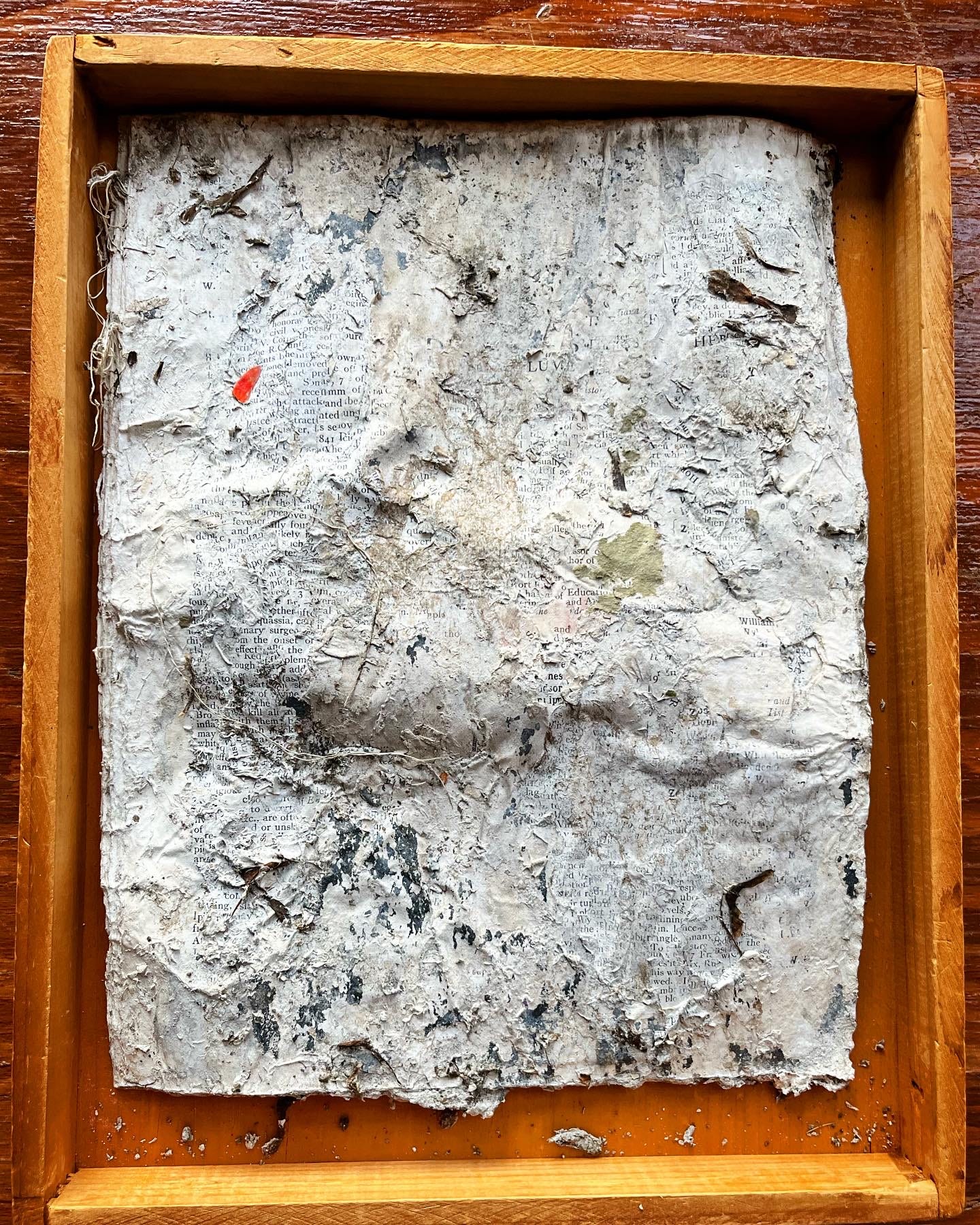
I invited Mary Ruefle to serve as the commencement speaker for the MFA program I direct. On the day of graduation, she brought a prop with her: a flat, rectangular wooden box, in which was a kind of rectangular dried pulpy mush. It looked like what it was: pulped paper—like the material used to make paper. Of course it WAS paper, as the object is a book that Mary keeps in her backyard. Exposed to the elements, she is able to watch the book decompose over time. Why do such a thing? Well, Ruefle tells us, this is fate of all literature, after all. Eventually, every book will break down into mush, into ash, into compost and carbon, and air. Mary’s decomposing book is a kind of memento mori, a reminder of our own vanity, and that the “momentary stay against confusion” that is a poem, is not deathless, but momentary, fleeting, finite. Quelle drag, no?
But no! She goes on to tell us what we must know. She writes, “I am not ashamed to take what joy I can in writing. It is neither a little joy nor a small solace, it is enormous. My advice to you is to sit down, look out the window, and go to work. Through a small hole in a high fence, you are offering a gift to a stranger.”
6. The Post Office is a miracle.
Mary served as the Poet Laureate for the State of Vermont for several years, an appointment she accepted the year before the pandemic. She went on to receive a fellowship from The Academy of American Poets to fund a public project. This was in the spring of 2020, just when the COVID pandemic was settling in and scotching everyone’s ambitious plans for poetry readings and festivals and workshops in schools and libraries and parks. Of all the Poets Laureate awarded grants that year, only Mary’s plans went unchanged. Mary’s project was simple: She planned to use the phone books at the public library to get the addresses of 1000 Vermonters. She then copied 1000 poems she admired (there were some repeats, but mostly not). She then put a poem in an envelope, addressed it to one of her 1000 Vermonters, and mailed them a poem. The author’s names were on the poems, but she included no other information, and she did not supply a return address. The poems were handed along from post office to post office to letter carrier to mailbox and delivered. If they weren’t delivered, Mary had no way of finding out, as she hadn’t supplied a return address. Mary assumed most of these wound up in the trash, but she suspected some didn’t. Someone, somewhere in Winooski, or Tinmouth, or Dummerston walked down their gravel road to the mailbox and found an envelope with a handwritten address, inside which was some mysterious document in the form of a poem. Maybe it wound up on the refrigerator, or maybe it was used to light the woodstove—no one had any way of knowing. I am enormously proud to report that Mary chose one of my poems to send to a Vermonter, and so I get to imagine someone in Eden, or Blissville, or maybe Avery’s Gore way up in the Northeast Kingdom got my strange poem about visiting the town in Northern Germany where Rilke once lived, and where I had found myself one lonely spring a decade ago.
Mary Ruefle famously does not use email. When she first encountered email, she thought—like the boy in the poetry section of the bookstore—NOPE. Not for her. And doesn’t she look like the one who made the right call? As we know, email only begets more email, and she decided she would not feed the beast. As a result, when I have business to conduct with Mary, I do what we all used to do which is I pick up the phone and dial her number, and she usually answers and we talk on the phone. That, or I write her letters and postcards.
7. On postcards
I, like Mary, LOVE postcards. I love their semi-public nature, exposed as they are on one side to any curious reader (postal carrier?) in whose hands they might fall. On the other side is an image—a photo of an attraction, or a work of art, or a curiosity. Space is limited, and so one has to be brief, clear and immediately interesting. How like a poem a postcard is! A recipient, an image, the separation of time and space, I and thou, wish you were here. And the possibility of someone also listening in, reading the message that was not intended for them, but having it shared with them nonetheless. I have a box with all the postcards I have received from Mary, as like her treated books, she alters postcards as well. Here her principle of composition is easy: A piece of found text is applied to the image on a postcard, usually with a piece of scotch tape.
Of all of Mary’s work, I find her altered postcards the funniest. The juxtaposition of image and found text in her postcard collages tends to the absurd, the images on the cards are as varied as the form itself and fall into the category of the received and chosen, as opposed to the composed—again, writing with the eye, rather than with the hand. Word and image—think of a caption, an illustration, a diagram, a subtitle, a billboard or graffiti. Ruefle applies language to the surface of an image, and we suddenly have an authorial voice, and often a kind of shadowy narrative that erases the anonymity of a commercially produced postcard and gives it a comic point of view.
In the early 20th century, the postcard as literary form was embraced by the Young-Vienna café society writer Peter Altenberg, who loved the limitation of space the postcard provided. In his cape, sandals, walrus mustache and broad-brimmed hat, he sat in Café Central writing on postcards which he mailed to newspapers and to friends. The composer Alban Berg composed Five Orchestral Songs After Postcards by Peter Altenberg, and when performed under the direction of Schoenberg, the audience responded by rioting.
I want to say something here about Mary’s postcards being a riot, but no. They are more subtle than Berg’s composition, more ironical, and yes—she does send them through the mail. As I mentioned, I have a box of postcards with captions that Mary has sent me over the years, and they are a treasure.
8. “Apple In Water”
In the bathroom of the taproom-bar of Left Bank Ciders in Catskill NY, there is a printed text in a small frame. As you dry your hands, you can read the text, which is a poem by Mary Ruefle appropriate to an establishment that ferments ciders from apples harvested in the Catskills and Hudson Valley. It’s called “Apple In Water.”
Apple In Water

I was swimming
with the taste of apple
in my mouth
a shred of appleskin
between my teeth I guess
It doesn’t get any better than this
said the water
These are troubled times
said the shred
and the apple, the apple
wasn’t really there,
only a lingering taste of it,
as if it were the last apple
or an earlier one that had lasted,
either way it was silent
and I swam with the silence
in my mouth, listening to
the pretty crimson dot
and the great slipping glimpser,
not knowing whether I heard
a night of love
or a love of night,
such was the knowledge gained
during that long languid swim.
This poem, which is from Ruefle’s 2019 collection DUNCE, uses the logic of dreams, but also the symbolic register of dreams. As the Jungians tell us, water when it appears in dreams, is indicative of the subconscious, the great flow of knowledge that is unavailable to us but for glimpses. Mary, an ardent swimmer, has placed this speaker in the water, where speaker, element and object are all alive and all capable of speech. The water speaks, and so does the apple, and what is revealed is the pure knowledge of NOT knowing. A night of love, or a love of night—ah which is it? The speaker never finds out, but names this as the knowledge that is gained.
9. On Secrets
In Ruefle’s essay, “On Secrets,” from her collection of essays and talks about writing and poetry called Madness, Rack, and Honey,” she writes, “Very often, as a teacher and reader I encounter poems that do not take my feelings into account, and this is unacceptable to me! Every time I read a poem, I am willing to die, insofar as I am surrendering myself to the mercy of someone else’s speech, and I do not want to die in the presence of someone else’s vile corruption of feeling. You are supposed to be preparing me for my death. Do not misunderstand me: rage sadness uncertainty, discomfort, awkwardness, resignation, and lament are subjects of a great many poems I am very willing to hear, as are poems of joy, surprise, delight and tenderness, as are poems that renounce emotion in favor of a detached observation of the outer world or indulge only in an exploration of language itself, all of the poems of the wandering spirit in search of an unknown finality, in search of a secret.
10. Back to erasure
The Robert Frost Stone House in Shaftsbury, Vermont is an 18th century Dutch colonial house which was home to Robert Frost and his family from 1920 to 1929. It’s a charming house that sits on 80 acres on which Frost imagined he would grow apples. Frost wasn’t a very good farmer, and nine years is hardly enough time to establish an orchard, but he did win the Pulitzer Prize while living in that house, and he also wrote a poem there we all know, which is Stopping by Woods On a Snowy Evening. I’ll read that poem in its entirety, because why not?
Stopping by Woods on a Snowy Evening

Whose woods these are I think I know.
His house is in the village though;
He will not see me stopping here
To watch his woods fill up with snow.

My little horse must think it queer
To stop without a farmhouse near
Between the woods and frozen lake
The darkest evening of the year.

He gives his harness bells a shake
To ask if there is some mistake.
The only other sound’s the sweep
Of easy wind and downy flake.

The woods are lovely, dark and deep,
But I have promises to keep,
And miles to go before I sleep,
And miles to go before I sleep.

The Robert Frost Stone House Museum has the problem of many writers’ house museums, which is that visitors have to stand around reading things posted on the walls of the house, and this is boring. So when the director of the museum decided to show Mary’s work in the house, I was thrilled! The house was going to be used not as a kind of shrine to the past, but as a place where the work of a living poet and artists could be seen. The exhibition of Mary’s erasures and collage postcards was to be installed in a single room in vitrines, and in frames on the wall. Everything fit perfectly, but one whole wall had “Stopping By Woods On a Snowy Evening” stenciled on it. This had been done many years earlier, and after discussing it, Erin (the director) and I decided it was time to paint over the stenciled poem. Now the exhibition at the museum was delayed by almost a year due to the pandemic, and we kept pushing back the opening. Finally, we got to a place where the museum had reopened, and Mary came to have a look at the exhibition space. We showed her the vitrines, and the available wall space, and a corner shelf where other objects could be shown. Erin mentioned that we had decided to paint over the stenciled poem on the wall, and Mary paused, then said, “Or I could erase it.”
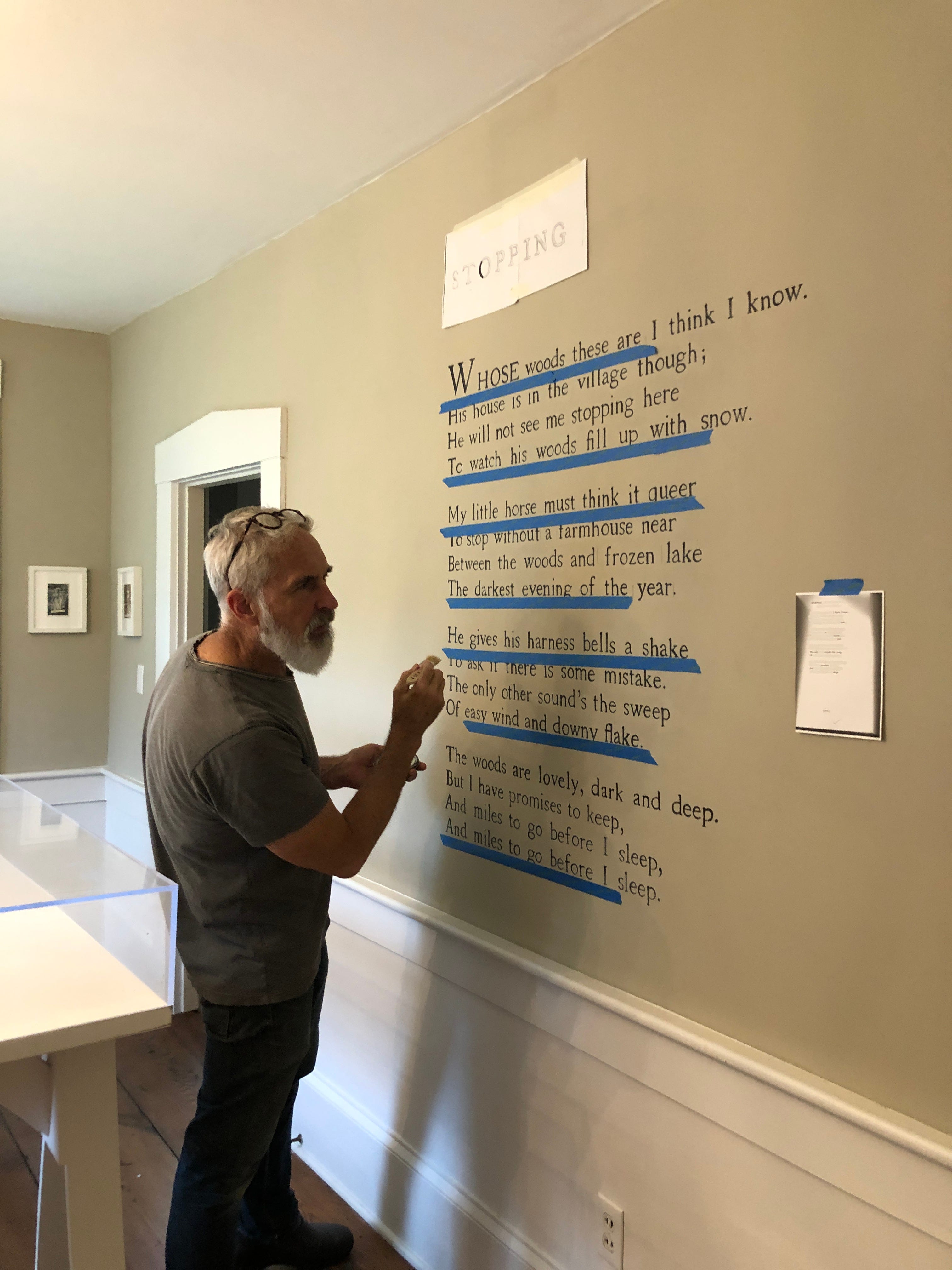
I will pause here to note that Mary loves Robert Frost, or the poems of Robert Frost. You may recall that earlier in this talk, I quoted Mary saying that she was not interested in erasing literature she admired. In this case, she made an exception. Mary took a copy of the poem and from Stopping by Woods on a Snowy Evening, she created the following poem:
Stopping
I think I know
now
a
frozen year
The only sound’s the weep
Of promises
and sleep.
An erasure for the pandemic: I think I know now a frozen year. How apt to reduce what we thought we once knew—the jaunty lines of iambic tetrameter, ordered into quatrains—now fragmentary, quiet, remote. Gone is the little thinking horse, the farmhouse, and even the woods and the frozen lake, erased. What is left is the poem that slept inside the poem, thawed out a bit by the writing eye of Mary Ruefle.
Lovely, Mark. Thank you!
What an incredible tribute to her. Thank you for this.